Adding an ashtray significantly increases the strength of a knife made of frozen faeces
Effect of ceramic cullet content on three-point bending
1International Federation of Domestic Science, Institute of Household Physics
2University of Nowhere, Department of Applied Metaphysics
Abstract
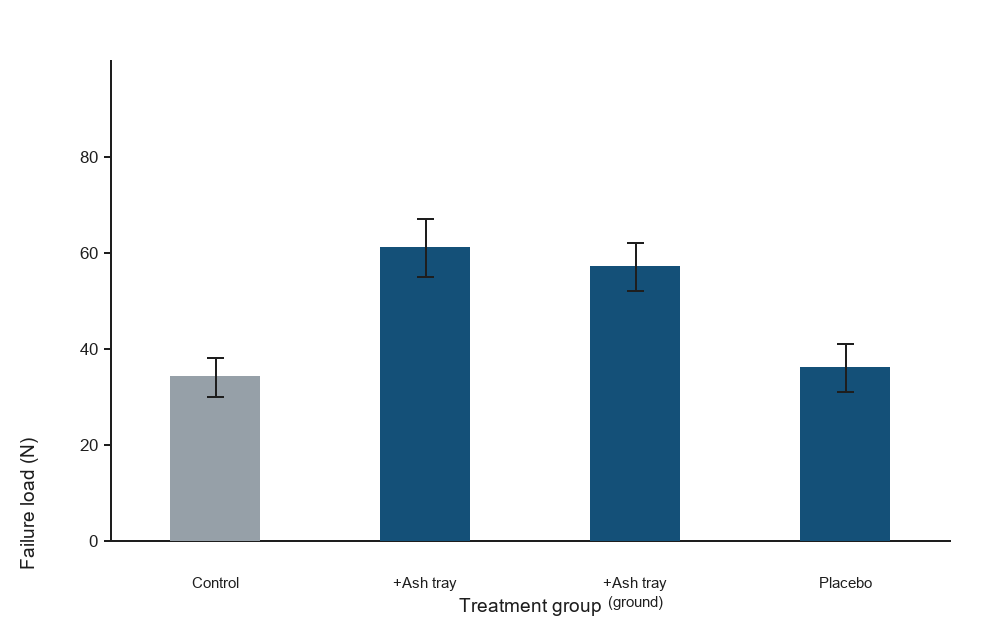
The frozen-faecal knife (FFK) is a traditional household implement whose mechanical properties have never been quantified. We prepared 120 specimens with 0%, 10%, 20% and 30% ashtray cullet and tested them in three-point bending. At 20% cullet the mean failure load rose from 34 N to 61 N (p < 0.001), but the fracture surface developed a reflection “not belonging to any known mineral”.
Methods
Raw material was donated by three volunteers, frozen at −18 °C, shaped into blades, mixed at the surface with cullet, and held for 28 days. One author inspected the specimens daily, which he reports “helped”.
Results
See Fig. 2. The 20% group was strongest; the 30% group fell back because of internal cracking. Microscopy revealed a possibly sintered interface between cullet and matrix, the origin of which is unexplained. The FFK softened whenever the kitchen rose above 4 °C, which we treat as a limitation rather than a finding.
Discussion
We cannot account for the interface. One author proposes calling it the ashtray effect and applying for a grant that does not exist. We take no position on that proposal.
References
1. Okada, T. Testing methods for household blades. J. Nowhere Univ. 12, 33–41 (2025).
2. Novák, P. Ceramic inclusions in vernacular composites. Mater. Doubt 4, 201–210 (2024).
3. Okada, T. & Bhattacharya, S. Phase stability of frozen-faecal blades at room temperature. J. Cold Mater. 2, 14–22 (2025).